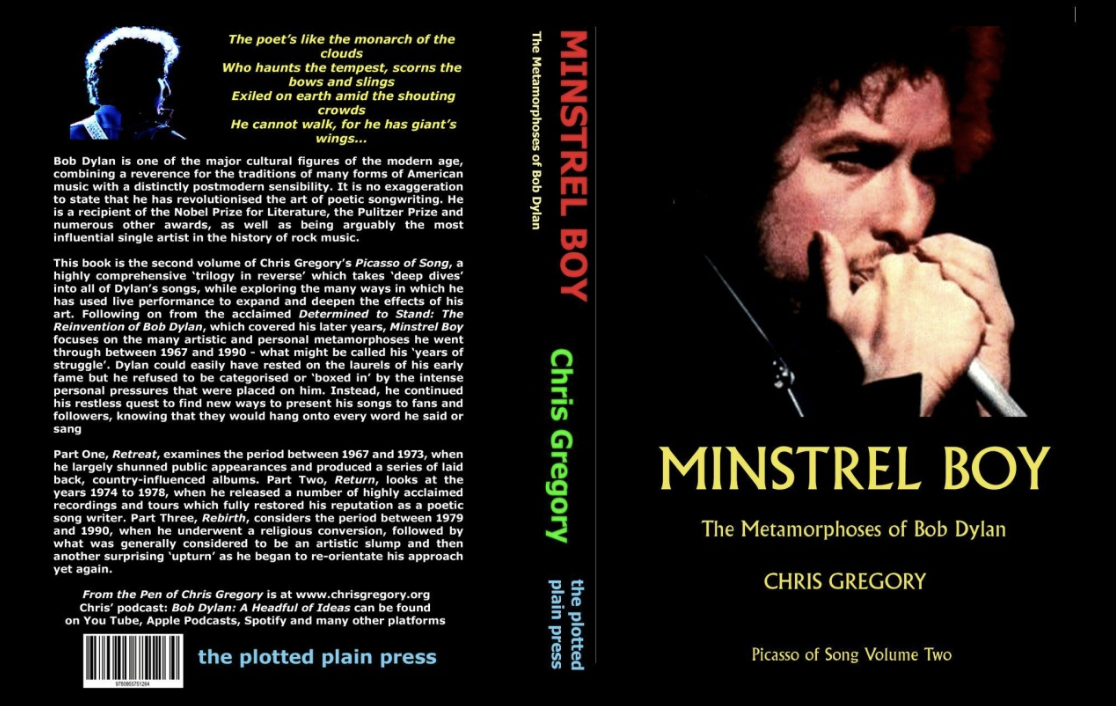
A new major study of Bob Dylan’s mid-career years is set for release in October 2025. Minstrel Boy: The Metamorphoses of Bob Dylan, written by literary and cultural commentator Chris Gregory, offers an in-depth look at Dylan’s development as an artist between 1967 and 1990. As the second installment of Gregory’s Picasso of Song trilogy, this book builds upon the foundation laid in his previous critically acclaimed work, Determined to Stand: The Reinvention of Bob Dylan. We spoke with the author in a wide-ranging conversation about the book.
If “Picasso of Song” is the guiding metaphor, what’s Dylan’s cubist moment between
1967 and 1990—where form itself gets fractured and reassembled—and how do you
hear that on record or on stage?
‘Blood on the Tracks’ is the key moment, when he began to introduce multiple
perspectives, time shifts etc into the songs – especially in ‘Tangled Up in Blue’ and
‘Idiot wind’. Also these songs move through many different versions. The influence of
Picasso in particular means that meaning in the later songs is never fixed.
Volume Three will go back to the early years. After living with the middle period so
intensely, what question about Dylan’s beginnings now feels most urgent to answer?
How on earth did he write so much that was so inspired, at such a staggeringly young
age? Also how did he fuse so many lyrical and musical traditions together? How did
he redefine both rock and folk music as musical forms?
The “born-again” years still polarize fans. How did you approach those albums and
shows to balance cultural context, spiritual intent, and musical craft without collapsing
into either apology or dismissal?
A difficult task! Especially as so many of the earlier Christian songs tend to try to
eliminate the ambiguity which is such a strong feature of Dylan’s work. I have praised
the many live performances of the ‘religious era’. Some of the songs could be
discussed fairly briefly as their lyrics are minimal. One must assume that Dylan was
sincere in all his protestations of this period. What I found especially interesting was
the link between the ‘gospel’ and ‘post gospel’ songs, in which we can trace Dylan’s
embrace of a much broader religious viewpoint. In late ‘80s songs like When the Night
Comes Falling From the Sky and Ring Them Bells we also see him casting scorn of
religious cultists. In general I have tried to treat the religious material respectfully,
without trying to ‘psychoanalyse’ Dylan’s reasons for embracing religion.